











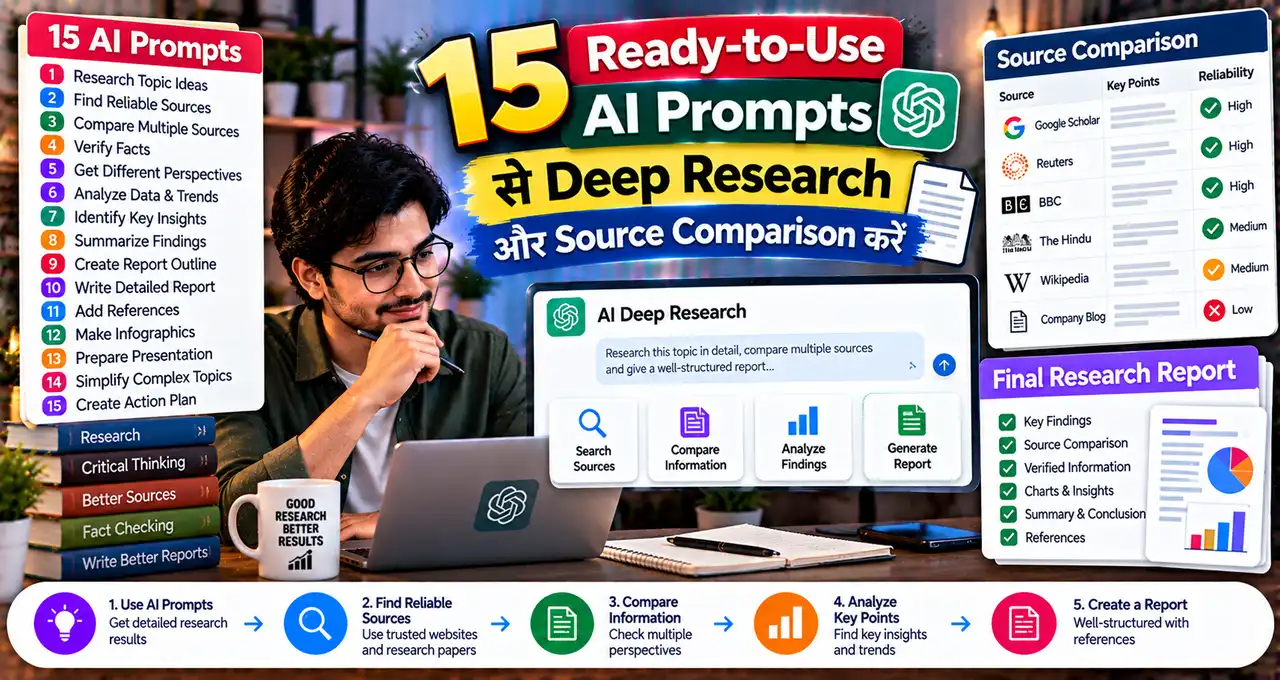




Deep research AI prompts मदद करते हैं जब AI की report में links तो हों, लेकिन जवाब verify करना मुश्किल हो।
यहाँ 15 prompts हैं। कुछ research शुरू करने के लिए हैं और कुछ बनी हुई report में पुराने claims, कमजोर citations और missing evidence पकड़ने के लिए हैं।
अपने topic के साथ date, audience और decision बदलें। शुरुआत अपनी current stage वाले prompt से करें। पूरे research workflow के लिए अंत में reusable Master Prompt भी है।
इस लेख में आप क्या सीखेंगे?
- Research का scope तय करना
- सही sources चुनना सीखें
- Conflicting claims को समझना
- Citations का audit करना
- Decision note तैयार करना
Deep research AI prompts कैसे इस्तेमाल करें?
पहले तय करें कि आपको कोई fact verify करना है, sources compare करने हैं या recommendation चाहिए। हर stage पर पूरा नया research task चलाने की ज़रूरत नहीं है।
ChatGPT के official Deep Research guide में proposed research plan review करने और output के source links जाँचने की प्रक्रिया बताई गई है। Account में feature और source access अलग हो सकते हैं।
नीचे के prompts का output tool की access पर निर्भर है। किसी source तक पहुँच न हो, तो AI को unavailable लिखने दें। Private document upload करने से पहले permission और data sensitivity जाँचें।
हर prompt में fields अंत में दिए हैं। इन्हें भरें। Citation खोलकर decisive claims स्वयं जाँचें, खासकर जब किसी fact पर publication या खरीद का फैसला निर्भर हो।
Prompt 1: Question को research brief में बदलें
Best for: Scope तय करना
Style: Planning
Turn the supplied topic into a practical research brief for the decision below.
Restate the problem in one sentence. Define what the research must establish, who will use the answer and what falls outside the scope. Replace broad terms such as “affordable” or “widely available” with measurable criteria when the supplied context supports them. Mark any threshold that still needs my input.
Break the question into three to five subquestions. Rank them by how much their answers could change the decision. For each subquestion, name the type of source to consult, the minimum evidence required and the condition that would let you stop searching.
Ask one focused clarification if a missing detail could materially change the scope. List any remaining assumptions and deliver a brief another researcher could follow independently. Stop after the brief and identify the first source to check.
Topic: [Exact Topic]
Decision: [Decision to Make]
Audience: [Intended Reader]
Deadline: [Date or Time Limit]
“Best editor” जैसी query से शुरुआत करें और operating system, export तथा budget जोड़कर scope छोटा करें।
Prompt 2: Primary sources की priority list बनाएँ
Best for: Source selection
Style: Evidence planning
Build a source plan for the supplied research question.
Match every major claim to a source capable of verifying it. Use official documentation for product requirements, original studies for measured outcomes and public records for formally recorded facts. Identify where independent reporting or a direct test would add evidence beyond the publisher’s own account.
Record the publisher, author where available, publication or update date, relevant section and scope for each source you can identify. Mark archived material with its date. Explain what each source can establish and where its authority ends.
Prioritize sources that could resolve the decision first. Suggest two focused search queries for gaps in the source list. Where primary material is inaccessible, identify any secondary account and describe what still needs verification. Use confirmed URLs when available and label suggested searches as searches.
Question: [Exact Research Question]
Location: [Country or Region]
As-of date: [Verification Cutoff]
Product support के लिए official docs खोजें। User experience के लिए अलग evidence role रखें।
Prompt 3: दो tools का same-criteria comparison
Best for: Software evaluation
Style: Side-by-side comparison
Compare the two supplied tools using the same criteria and test scenario.
Describe the representative task first. For example, define the input file, target export resolution and device before comparing two editors. Separate must-have requirements from preferences and apply them consistently to both tools.
Build a table with one row per criterion. Record the exact feature, supported version, platform, plan, relevant pricing basis and official source. Label differences in billing period, currency or plan tier. Give separate columns to documentation and hands-on results. Mark untested features as “Not tested” and undocumented details as “Unconfirmed.”
Identify which unmet requirement could rule out each option. Finish with a conditional shortlist for the supplied audience and the smallest check needed before committing to either tool.
Tool A: [Exact Product Name]
Tool B: [Exact Product Name]
Test scenario: [Representative Task]
Must-have criteria: [Required Features]
Location: [Country or Region]
App और browser access को अलग rows में रखें। इससे एक ही feature name के नीचे दो अलग experiences नहीं मिलेंगे।
Prompt 4: Launch या rollout claim verify करें
Best for: News fact-check
Style: Timeline audit
Verify the supplied launch or rollout claim against the original evidence.
Build a timeline with separate entries for announcement, beta or waitlist access, rollout start and general availability. For each entry, record the event date, source date, region, platform, version and eligible account type where confirmed.
Read the original announcement alongside the relevant listing or documentation. Distinguish the date an article was published from the date its underlying event happened. If documentation changed after the announcement, record both dates. Treat forward-looking announcements as plans until a source confirms the corresponding release stage.
Use a short paraphrase of the passage supporting each timeline entry. Keep market-specific observations within their verified market. Finish with a plain-language verdict and two headline options that reflect the confirmed release stage.
Claim: [Exact Launch Claim]
Product: [Name and Version]
Region: [Target Market]
As-of date: [Verification Cutoff]
Release notes में “rolling out” दिखे, तो headline में “सभी को उपलब्ध” लिखने से पहले eligibility जाँचें।
Prompt 5: Conflicting sources reconcile करें
Best for: Contradiction review
Style: Evidence matrix
Reconcile the two supplied claims and explain what the evidence supports.
Split each statement into individually testable claims. Compare the exact wording, source type, publication date, underlying event date, region, version, plan and test conditions. If definitions differ, restate both claims on a comparable basis before deciding whether they conflict.
Create a table with columns for claim, source, applicable scope, likely reason for disagreement and decisive next check. Explain the evidentiary difference between a measured result, an official statement and a report repeating someone else’s account.
If the conflict can be resolved, show the specific evidence that resolves it. If it remains open, write a publishable sentence that reflects the verified portion. List the unresolved point and the smallest piece of evidence that could change the conclusion.
Claim A and source: [Exact Claim and URL]
Claim B and source: [Exact Claim and URL]
Decision: [What Depends on the Answer]
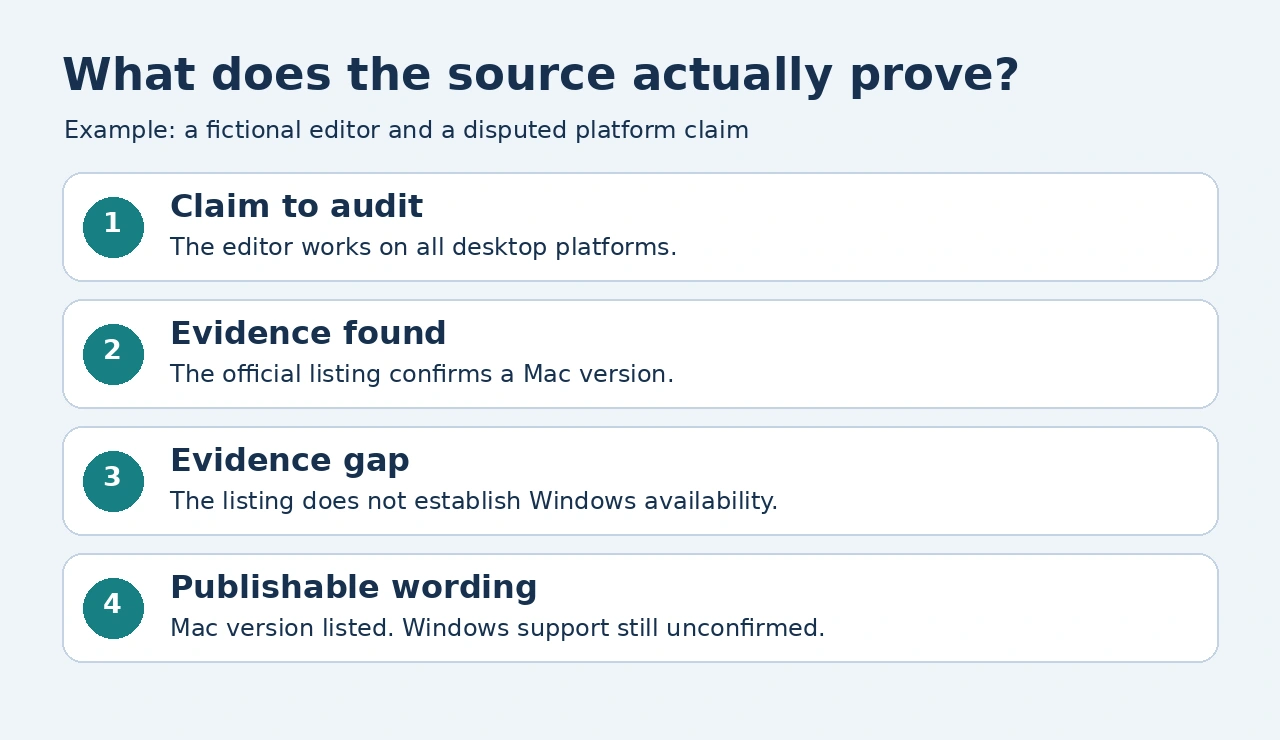
एक पुरानी version और एक नई version पर लिखे claims को एक ही test का result न समझें।
Prompt 6: एक report की citations audit करें
Best for: Publication review
Style: Claim verification
Audit the citations in the supplied report.
Extract the five claims most likely to influence the decision or publication. Split sentences with multiple factual assertions into separate entries. Open the cited page where access is available and locate the passage, table or section that addresses each claim.
Create a table with the original claim, cited URL, relevant passage or location, applicable scope and status. Use Supported, Partial, Unsupported or Inaccessible. Check whether the source confirms the specific number, population, date or version. Record the exact reason when support is partial.
Finish with a correction list showing the original wording, a publishable revision and the reason for the change. Preserve the verified part of each claim. Flag missing evidence and suggest the source type needed to resolve it.
Report: [Paste Report and Citations]
Audience: [Intended Reader]
Cutoff date: [As-of Date]
पूरे draft पर confidence score देने से बेहतर है हर महत्वपूर्ण claim की अलग स्थिति लिखना।
Prompt 7: Copied reports के पीछे original source ढूँढें
Best for: News research
Style: Source lineage
Trace the supplied coverage to the original source of the claim.
Inspect the byline, publication time, attribution, quoted speaker and outbound references for each link. Identify the original announcement, interview, study or dataset where possible. Use similar wording as a clue and confirm shared origin through attribution or a direct source link.
Group articles that repeat the same press release, agency copy or interview. Record any independent reporting, additional interviews or direct tests separately. Explain the exact part of the claim each independent contribution can verify.
Provide a compact map showing the original source, the outlets that reused it and the sources that added evidence. Put unclear origins in a separate section. Report how many independent lines of evidence support the specific claim and identify the strongest original source to cite.
Links: [Exact URLs]
Claim: [Statement to Trace]
चार articles में एक ही press release repeat हो, तो उसके claims के लिए original source पढ़ें।
Prompt 8: Numbers और definitions मिलाएँ
Best for: Data-heavy writing
Style: Quantitative audit
Check the reported numbers and the definitions behind them.
Extract the original value, unit, measurement period, denominator, geography and definition for each figure. Keep measures such as revenue, profit, orders and users in distinct rows. Record whether the figure is measured, estimated, forecast or reported by an interested party.
Check arithmetic separately from interpretation. Show the baseline, final value and formula for any change. Label percentage points and percent growth clearly. Record the assumptions behind annualization or currency conversion and specify the exchange rate date when applicable. Flag missing samples, denominators and definition changes.
Present a calculation row, a short explanation of whether the comparison is valid and one publishable sentence that retains the correct period and unit. Suggest headline wording within the limits of the underlying data.
Source figures: [Numbers or URLs]
Metric: [Exact Measure]
Period: [Date Range]
दो अलग denominators हों, तो percentages पास दिखने पर भी उन्हें सीधे compare न करें।
Prompt 9: PDFs में version differences खोजें
Best for: Document review
Style: Version comparison
Compare the two supplied documents for changes that affect the decision.
Identify the title, version, authority and effective date of each document. Establish whether each is a draft, adopted policy, explanatory note or FAQ. Match sections by subject and heading when their numbering changed.
Create a table with old wording or requirement, new wording or requirement, source location, effective date and practical impact. Distinguish changed requirements from formatting changes, moved text and deletions. Cite the page or clause for each material difference. Flag missing or unreadable pages and identify where manual review is needed.
Summarize changes that affect a task, deadline or decision. Keep minor differences in a separate list. Finish with the next action and the document that governs it, where the available evidence establishes its authority.
Document A: [File or URL]
Document B: [File or URL]
Sections: [Relevant Sections]
Decision: [Task or Requirement to Check]
नया upload हमेशा नया policy version नहीं होता। Document के अंदर की effective date देखें।
Prompt 10: Case study से fact और सीख अलग करें
Best for: Business story
Style: Historical sourcing
Extract verifiable facts and practical lessons from the supplied business case study.
Build a timeline that separates initial capital, later funding and business model changes. Record the publication date and the period covered. Attribute founder-reported figures and distinguish them from independently confirmed results. Keep historical sales and revenue tied to their original time period.
Identify which lessons transfer to the reader’s context and which depend on conditions such as geography, customer access, financing or fulfilment capacity. Propose one small pilot with a time limit, sample size and failure condition.
Provide a simple budget table with explicit cost assumptions. Label illustrative numbers clearly. Finish with a lesson the reader can test and one material unknown. Keep company practices, your inferences and the suggested pilot visibly separate in the output.
Case study: [Original Article or Report]
Business context: [Reader’s Situation]
Pilot budget: [Maximum Spend]
कहानी का useful lesson निकालें, लेकिन नए reader की situation में वही profit assume न करें।
Prompt 11: Market demand और interest अलग करें
Best for: Idea validation
Style: Customer evidence
Assess demand for the supplied product idea in the target market.
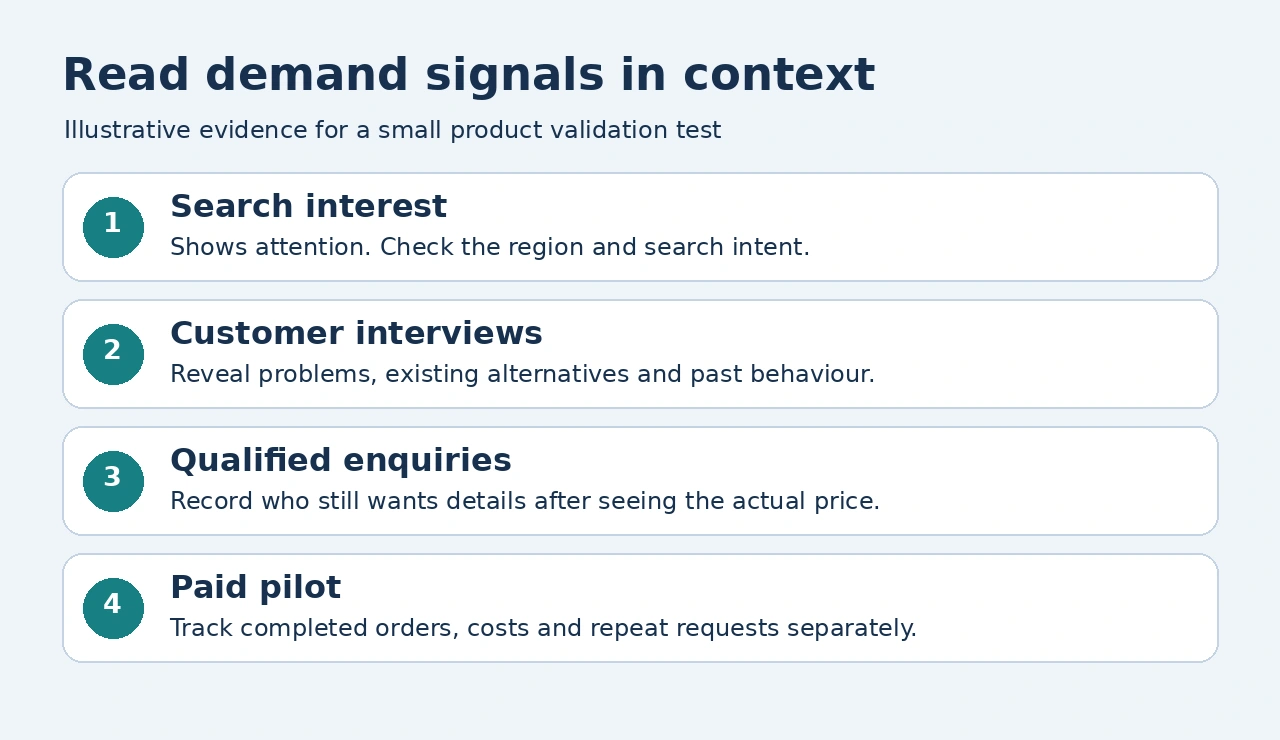
Separate search interest, interviews, qualified enquiries and paid orders. Describe what each signal can establish and record its geography and date. Treat a buyer who still asks for details after seeing the actual price as a different signal from a casual comment or like.
Suggest three small tests that can be run within seven days. Use interview questions about past behaviour, current alternatives and prior spending. Define a success threshold, a spending cap and a time limit for each test using the supplied context. If a threshold requires my input, provide a field for it.
Finish with separate rules for continuing, revising or pausing the idea. Connect each rule to a result I could observe and record during the pilot.
Product: [Exact Product Idea]
Buyer segment: [Intended Buyer]
Location: [Target Market]
Budget: [Test Spending Cap]
Likes और comments interest दिखा सकते हैं। Paid pilot खरीदने की इच्छा का अलग signal देता है।
Prompt 12: Counter-evidence खोजें
Best for: Recommendation check
Style: Adversarial review
Test the supplied recommendation by looking for evidence that could overturn it.
List the assumptions the recommendation depends on. For each assumption, identify what evidence would weaken it and search for the strongest available challenge. Rank up to three objections by their impact on the decision.
Give each objection a source, date, relevant scope and practical consequence. Explain whether it applies to the intended plan, region, version or audience. Distinguish substantial counter-evidence from criticism based on a different use case. For the strongest unresolved objection, specify the test or document that would clarify it.
Finish by stating whether the recommendation holds, becomes conditional or changes. Explain the decisive evidence in plain language and list the smallest next check that would improve confidence.
Recommendation: [Exact Recommendation]
Criteria: [Decision Criteria]
Alternatives: [Options to Consider]
As-of date: [Verification Cutoff]
Recommendation पहले से बन गई हो, तब यह prompt confirmation bias पकड़ने में मदद करता है।
Prompt 13: Research को reader-first outline में बदलें
Best for: Blog planning
Style: Editorial synthesis
Turn the verified research notes into a reader-first article outline in the requested language.
Start with the reader’s problem and the first practical action. Give each section one main question and one useful outcome. For each section, list the claim it can support, the relevant source and a concrete example. Label examples as documented cases, hypothetical scenarios or demonstrations.
Arrange the outline in the order a reader would make the decision. Suggest a diagram only where it clarifies an evidence comparison or sequence. Put unconfirmed details in a separate review list and identify the source needed to check them.
Check that the headline and introduction promise only what the outline delivers. Keep source links close to their claims and preserve exact dates, figures and verified scope throughout.
Verified notes: [Research and Source Links]
Reader: [Target Audience]
Working headline: [Proposed Headline]
Article language: [Hindi / English / Mixed]
Length: [Target Range]
Outline में source links रखें ताकि final writer headline और body दोनों में scope बचा सके।
Prompt 14: एक page का decision memo बनाएँ
Best for: Client handover
Style: Decision memo
Convert the supplied research into a one-page decision memo.
Open with the recommended action and its most important condition. Use a compact table showing the options, required criteria, verified results and open questions. Explain which evidence drove the recommendation and provide direct links to the relevant passages or documents.
If different options fit different situations, give each option a clear decision trigger. Identify any unknown that could materially change the choice. For each next action, name the responsible role and the deadline, using supplied information or clearly labelled placeholders.
End with a review trigger that explains when the decision should be reconsidered. Keep the appendix focused on source links needed to verify decisive claims. Use wording suitable for the intended decision maker.
Research report: [Report and Links]
Decision maker: [Intended Reader]
Decision: [Action Under Consideration]
Deadline: [Decision Date]
Client को पूरी source dump देने के बजाय पहले decision, condition और next step दिखाएँ।
Prompt 15: पुरानी report को targeted refresh दें
Best for: Recurring research
Style: Change tracking
Refresh the supplied report by checking only the claims likely to have changed.
Identify time-sensitive claims such as pricing, eligibility, rollout status and compatibility. Record the old value, old source and previous verification date. Check current primary sources against the same plan, region, version and definition.
Build a change table with previous value, current verified value, evidence date, source and decision impact. Explain when a difference reflects a revised definition or broader scope. Mark unavailable pages or missing confirmations as evidence gaps. Leave stable background in a brief unchanged summary.
Rank changes by how much they affect the reader’s decision. Supply replacement wording for material changes, identify any manual verification still required and suggest a practical date for the next review.
Old report: [Report or URL]
Last verified date: [Previous Check]
Current date: [New Cutoff]
Priority claims: [Claims to Refresh]
Pricing, rollout और compatibility हर बार बदल सकते हैं। Stable background को अलग रखें।
AI report में claim-level check का छोटा example
मान लें AI कहता है कि Tool A का desktop editor सभी users के लिए available है। Official listing केवल Mac version दिखाती है। इससे Mac listing का claim support होता है। सभी users या Windows availability का conclusion अलग evidence माँगता है।
Source note में लिखें: exact claim, URL, access date, version और supported scope। फिर publishable wording चुनें। उदाहरण है “Official listing में Mac version मिला। बाकी platform availability की पुष्टि बाकी है।”
अगर decision सिर्फ Mac use के लिए है, तो अगला check supported OS और export conditions का है। Windows के लिए report लिख रहे हैं, तो evidence मिलने तक recommendation रोकें।
Reusable Master Prompt और stop rule
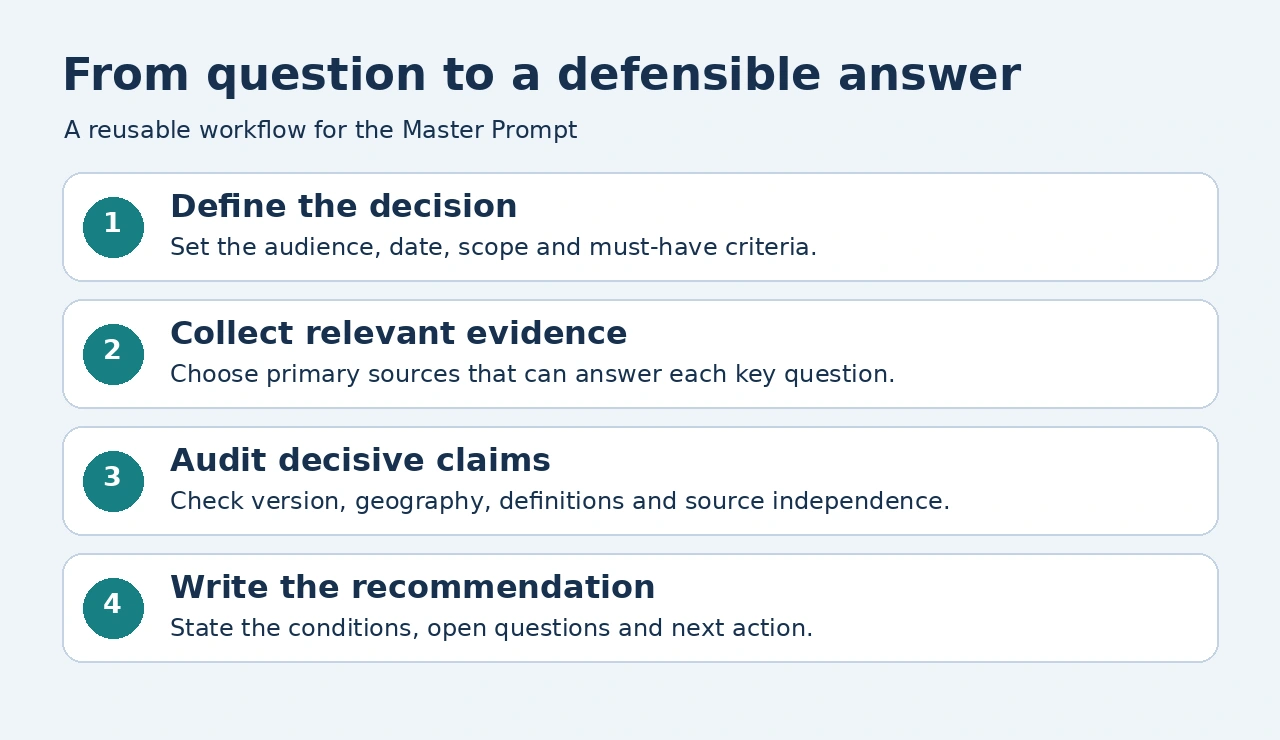
Research question, scope, criteria और output format एक जगह रखें। लंबी report चलाने से पहले दो या तीन decision-changing claims तय करें।
Research the supplied question and produce a decision-ready report supported by traceable evidence.
Start with a brief that states the main question, up to four subquestions, the intended audience, the decision and the required output. Define the scope by region, dates, version and platform where relevant. Ask one focused question if missing context could change the conclusion. Record any remaining assumptions and distinguish mandatory requirements from preferences.
Choose sources that can directly answer each subquestion. Use official documentation for product requirements and policies. Use original datasets, studies or independent measurements for market and outcome claims. Identify which articles share an original announcement, dataset or interview. Count independent evidence separately from repeated coverage. If a source cannot be opened, record the access gap and the exact material needed for manual verification.
Create an evidence table for claims that could change the decision. Include the claim, source URL, publication or update date, relevant section, region or version, and status. Use Supported, Partial, Conflicting, Inaccessible or Unknown. Record units, denominators, sample sizes and assumptions where relevant. Do not invent links, quotes, page numbers, figures or test results.
When sources disagree, compare definitions, dates, populations and versions before evaluating the conflict. State which evidence carries more weight and explain why. Separate documented observations from your interpretation. For unresolved conflicts, describe the smallest check that could resolve them.
Open the final report with the recommended decision and its most important condition. Follow with a concise comparison, the evidence table, open questions and next actions. Link each decisive claim to its supporting source. End with the evidence that would change the recommendation and check that every headline, figure and conclusion reflects the verified scope.
Research question: [Exact Question]
Decision: [Decision to Make]
Audience: [Intended Reader]
Scope: [Region, Dates, Platform and Version]
As-of date: [Verification Cutoff]
Must-have criteria: [Required Checks]
Known sources: [Links or Files]
Constraints: [Budget, Time and Source Access]
Report language: [Hindi / English / Mixed]
Output format: [Comparison Table / Decision Memo / Article Brief]
जब must-have claims verify हो जाएँ और बाकी unknowns decision न बदलें, report finalize करें। कोई critical gap बचा है, तो एक targeted follow-up करें।
आख़िर में एक छोटी सी बात
सही prompt research का scope छोटा और evidence review आसान बनाता है। Tool का output पढ़ते समय सबसे पहले उन claims को जाँचें जिन पर आपका decision निर्भर है।
अगली report के लिए यहाँ से केवल दो prompts चुनें। एक scope तय करने के लिए और दूसरा final claims audit करने के लिए। समय के साथ अपना source log बनाएँ ताकि अगली review में सिर्फ बदली हुई जानकारी फिर देखनी पड़े।
आप कौन-सी report पर इन prompts को आज़माएँगे, comments में बताएँ। यह collection किसी ऐसे साथी से share करें जो AI से research और fact-checking करता है।