















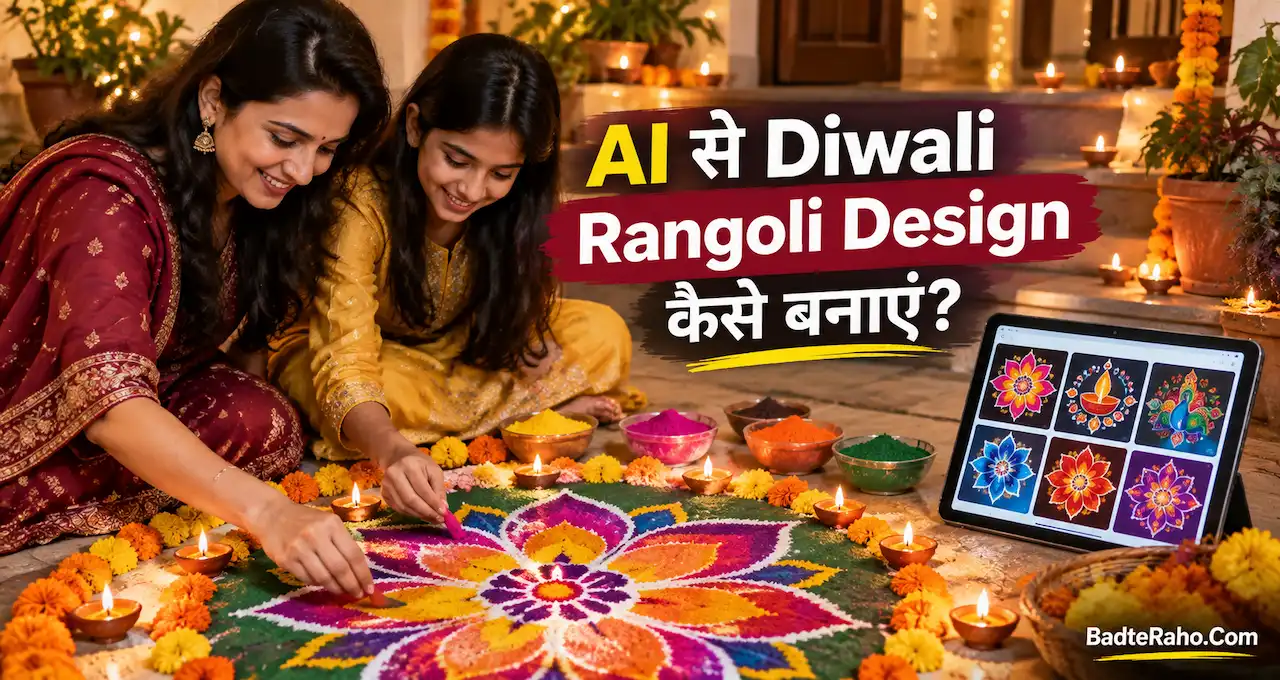




Diwali की rangoli हर साल सुंदर बनती है, लेकिन एक जैसा design जल्दी repeat होने लगता है।
AI आपको सिर्फ़ “नई rangoli image” नहीं देता। सही prompt से आप पहले ही तय कर सकते हैं कि design floral होगा, geometric होगा, traditional लगेगा या modern। Size, color palette और difficulty भी control की जा सकती है।
इस guide में आपको 25 ready-to-use Diwali rangoli AI prompts मिलेंगे, जिन्हें आप सीधे copy-paste कर सकते हैं। साथ ही सीखेंगे कि prompt को अपने entrance, floor space और available colors के हिसाब से कैसे बदलें। आखिर में reusable Master Prompt भी मिलेगा।
सबसे useful result वही है जो screen पर अच्छा दिखने के साथ असल floor पर बनाया भी जा सके।
इस लेख में आप क्या सीखेंगे?
- Rangoli style चुनना
- सही prompt structure बनाना
- 25 ready-to-use prompts
- Design practical रखना
- Colors customize करना
- Master Prompt use करना
AI से Rangoli Design बनाने से पहले क्या तय करें?
Prompt लिखने से पहले जगह, size, difficulty और material तय करें। यही details design को practical बनाती हैं।
छोटे entrance के लिए compact layout रखें। बड़े courtyard में layered design काम कर सकता है। Beginners के लिए bold shapes और कम colors आसान रहते हैं।
Material भी पहले decide करें:
- rangoli powder
- flower petals
- rice flour
- diyas के साथ mixed design
- stencil-friendly pattern
AI image को reference design की तरह देखें। Floor पर details simplify करना normal है।
अगर prompt writing नया है, तो Prompt Engineering क्या है? AI से बेहतर जवाब पाने के लिए Prompt कैसे लिखें? helpful रहेगा।
Rangoli Prompt का Simple Formula
एक strong rangoli prompt में ये elements useful रहते हैं:
Shape + Main Motif + Color Palette + Symmetry + Material + Floor Context + Size + Difficulty + Top View + Restrictions
उदाहरण के लिए सिर्फ़ “beautiful Diwali rangoli” लिखने के बजाय यह बताएं कि design circular है या square। साथ में lotus, diya, peacock feather या geometric motif भी specify करें।
Top-down view मांगना useful है, क्योंकि angled image physical layout समझने में मुश्किल कर सकती है।
Prompt में यह भी साफ़ होना चाहिए कि final design:
- flat floor pattern हो
- hand-drawable हो
- sections clearly separated हों
- actual available space में fit हो
- unnecessary 3D effects न हों
- tiny impossible details न हों
नीचे हर prompt के आखिर में editable details एक साथ दी गई हैं। User को मुख्य रूप से उसी bottom section में अपनी information बदलनी है।
25 Ready-to-Use Diwali Rangoli AI Prompts
Prompt 1: Classic Floral Diya Rangoli
Best for: Main entrance, family home
Style: Traditional + bright
Create a practical top-down Diwali rangoli for an Indian home entrance.
Use a circular floral composition with one elegant diya motif in the center, surrounded by broad lotus petals and simple leaf shapes.
Keep the design symmetrical, flat on the floor and practical to draw by hand. Use bold outlines, medium-size sections and enough separation between colors for easy filling.
The central diya must remain the clear Diwali focal point rather than becoming a small decorative detail.
Keep the complete pattern inside the supplied floor size.
Avoid tiny micro-details, text, logos, photorealistic objects, 3D depth and impossible gradients.
Location: Main Entrance
Size: [3×3 / 4×4 feet]
Material: Rangoli Powder
Color palette: Red, Orange, Yellow, Green, White
Difficulty: [Beginner / Intermediate]
पहली बार बना रहे हैं, तो outer border simple रखें। Central diya और बड़े petals ही main attraction बने रहें।
Prompt 2: Minimal Doorway Rangoli
Best for: Small entrance, apartment
Style: Minimal + elegant
Create a compact practical Diwali rangoli designed specifically for a small apartment doorway.
Use a clean semicircular layout that sits directly in front of the door while leaving the walking path clear.
Build the pattern from three broad floral arcs, two simple diya motifs and one narrow decorative border.
Keep all lines bold and all fill areas large enough for quick hand execution. The two diya motifs should make the Diwali context immediately recognizable without overcrowding the doorway.
Show the design in a strict top-down flat floor view.
Avoid tiny dots, dense patterns, complex shading, text, decorative objects outside the rangoli boundary and 3D perspective.
Location: Apartment Doorway
Size: [2×3 feet]
Material: Rangoli Powder
Color palette: White, Maroon, Mustard Yellow, Deep Green
Difficulty: Beginner
Walking space कम हो, तो full circle की जगह semicircle बेहतर रहेगा। Door opening की direction पहले check कर लें।
Prompt 3: Lotus Mandala Rangoli
Best for: Living-room entrance, puja area
Style: Symmetrical + graceful
Create a detailed but physically practical lotus-mandala rangoli for Diwali.
Use one large eight-petal lotus in the center followed by two concentric rings of broader petals and geometric borders.
Maintain accurate radial symmetry and clear separation between every color section. Make the eight primary lotus directions easy to mark with chalk before filling.
Keep individual shapes large enough to reproduce by hand instead of turning the design into digital micro-patterns.
Show a strict top-down flat floor view.
Avoid readable religious text, sacred scripts, extremely fine detailing, unrealistic lighting and 3D effects.
Location: [Living-Room Entrance / Puja Area]
Size: [4×4 feet]
Material: Rangoli Powder
Color palette: Magenta, Pink, Saffron, White, Teal
Difficulty: Intermediate
Chalk से पहले eight main directions mark करें। इससे mandala की symmetry maintain करना आसान होगा।
Prompt 4: Peacock Feather Rangoli
Best for: Creative festive centerpiece
Style: Artistic + colorful
Create a hand-drawable Diwali rangoli inspired by a single large peacock feather rather than a complete realistic bird.
Use one graceful flowing feather silhouette with broad layered eye-pattern sections and a curved decorative border.
Keep the design flat, stylized and practical for rangoli powder. Use smooth bold outlines and medium-detail sections that can be traced easily.
Maintain the recognizable peacock-feather form while avoiding realistic feather strands that would be difficult to reproduce on the floor.
Show the entire design from a strict top-down view.
Avoid photorealistic feathers, 3D effects, tiny repeated lines, text and unrelated background decoration.
Location: [Entrance / Hall / Open Floor]
Size: [3×5 feet]
Material: Rangoli Powder
Color palette: Royal Blue, Turquoise, Emerald Green, Purple, Gold-Yellow
Difficulty: Intermediate
Full peacock की जगह feather motif कम space में ज्यादा practical रहता है। Outline पहले complete करें, फिर inner colors भरें।
Prompt 5: Eight-Diya Radial Rangoli
Best for: Courtyard, open floor
Style: Festive + balanced
Create a practical radial Diwali rangoli with a small floral center and exactly the selected number of identical diya motifs arranged evenly around it like a clock.
Connect the diya motifs using broad curved petals and simple leaf patterns.
Keep every repeated section consistent so the user can draw one segment and repeat it around the circle.
The diya motifs must remain clearly recognizable and evenly spaced.
Use a strict top-down view with clean floor boundaries.
These are drawn diya motifs, not real flames. Avoid accidental extra diyas, text, micro-borders and unnecessarily thin lines.
Location: [Courtyard / Open Floor]
Size: [4×4 feet]
Number of diya motifs: 8
Material: Rangoli Powder
Color palette: Orange, Yellow, Red, White, Green
Difficulty: [Beginner / Intermediate]
पहले circle को eight equal sections में divide करें। इससे diya spacing जल्दी और साफ़ बनेगी।
Prompt 6: Marigold Flower-Petal Rangoli
Best for: Natural decoration, low-mess setup
Style: Floral + warm
Create a practical Diwali rangoli made primarily from real flower petals.
Build the design using broad concentric floral rings. Keep petals grouped in clear sections so the pattern can be assembled quickly without precision powder work.
Use green leaves only as narrow separators between selected flower rings.
Leave a neat central space for one real decorative diya holder while keeping enough separation from loose petals.
The final design should look physically achievable using actual petals rather than digitally painted flower textures.
Show the rangoli from a strict top-down view on a plain floor.
Avoid powder-style gradients, floating petals, impossible color transitions, text and excessive ornamentation.
Location: [Entrance / Courtyard / Indoor Floor]
Size: [3×3 / 4×4 feet]
Material: Real Flower Petals
Flower palette: Orange Marigold, Yellow Marigold, Pink Rose, White Flowers, Green Leaves
Difficulty: Beginner
Petal availability पहले check करें। दो marigold shades और एक contrasting flower भी enough हो सकता है।
Prompt 7: White Rice-Flour Kolam-Inspired Rangoli
Best for: Traditional entrance
Style: White linework + clean
Create a practical Diwali floor design inspired by traditional kolam-style white linework.
Use a simple dot-grid foundation with continuous curved white lines flowing around the dots.
Keep the pattern geometric, spacious and easy enough to reproduce with rice flour or white rangoli powder.
Add only one restrained festive color accent in the center so the white-line structure remains the main visual identity.
Show the full pattern in a strict top-down flat floor view.
Avoid random sacred symbols, readable religious text, extremely dense knotwork, disconnected line fragments and 3D decoration.
Location: Main Entrance
Size: [3×3 feet]
Material: [Rice Flour / White Rangoli Powder]
Accent colors: Saffron and Red
Difficulty: Intermediate
पहले dot grid बनाएं। Grid सही होगा, तो continuous lines follow करना आसान रहेगा।
Prompt 8: Alpana-Inspired Festive Rangoli
Best for: White floor art, elegant indoor space
Style: Folk-inspired + monochrome
Create a Diwali floor-art design inspired by Bengali alpana aesthetics.
Use flowing white rice-paste-style lines, broad floral forms, leaves and simple circular geometry.
Keep generous negative space between the motifs so the design feels handcrafted and graceful rather than overly dense.
Use a lotus-inspired central motif without adding readable sacred text or invented script.
Show the complete layout from a strict top-down angle.
Keep the design physically reproducible with continuous white strokes.
Avoid photorealistic objects, random writing, excessive micro-detail and 3D effects.
Location: [Indoor Entrance / Puja Area / Hall]
Size: [3×3 / 4×4 feet]
Material: [Rice Paste / White Rangoli Powder]
Floor color: [Reddish Brown / Neutral / Custom]
Difficulty: Intermediate
इस style में empty space भी design का हिस्सा है। हर gap को pattern से भरना ज़रूरी नहीं है।
Prompt 9: Kids-Friendly Easy Rangoli
Best for: Children with adult supervision
Style: Playful + simple
Create a kids-friendly Diwali rangoli using large, easy-to-fill shapes.
Build the design around one central flower, four large petals, simple circles and broad color sections.
Keep every section large enough that children can help fill it without needing precision work.
Use thick outlines and a flat top-down layout. Keep all flame-based objects out of the design so the activity remains safe.
Make the result cheerful and clearly festive through color and simple floral forms rather than intricate decoration.
Avoid tiny details, sharp complex geometry, text, glitter-like particles, open flames and intricate borders.
Location: [Indoor Floor / Courtyard]
Size: [2.5×2.5 feet]
Material: Rangoli Powder
Color palette: Pink, Orange, Blue, Yellow, White
Difficulty: Beginner
Adults outline बना दें और बच्चों को large color sections fill करने दें। इससे activity ज्यादा manageable रहेगी।
Prompt 10: Geometric Square Rangoli
Best for: Modern home, tiled floor
Style: Geometric + structured
Create a practical square Diwali rangoli built from nested squares, diamonds and four identical corner motifs.
Repeat the same decorative structure in all four corners and add one small circular floral motif in the center to soften the geometry.
Keep all straight lines crisp and easy to mark with ruler-guided chalk.
Maintain accurate four-way symmetry and make every fill section large enough for rangoli powder.
Show a perfect top-down flat floor layout.
Avoid random asymmetry, unnecessary curved clutter, text and 3D perspective.
Location: [Tiled Floor / Hall / Main Entrance]
Size: [4×4 feet]
Material: Rangoli Powder
Color palette: Deep Blue, Saffron, White, Magenta, Green
Difficulty: Intermediate
Tile joints को guide की तरह use किया जा सकता है। इससे square alignment जल्दी सही होता है।
Prompt 11: Corner Rangoli for Staircase or Room Edge
Best for: Limited space, room corner
Style: Quarter-circle + decorative
Create a practical quarter-circle Diwali rangoli specifically designed to fit into a 90-degree floor corner.
Build layered floral arcs outward from the corner point and include one simple diya motif with a broad leaf border.
The complete design must remain visually balanced even though only one quarter of a full circular rangoli is used.
Keep all artwork strictly on the floor and inside the supplied corner area.
Use broad outlines and large sections for easy execution.
Avoid elements climbing onto walls, tiny decorative details, text, clutter and 3D effects.
Location: [Room Corner / Staircase Landing / Hall Corner]
Size: [2×2 feet]
Material: Rangoli Powder
Color palette: Maroon, Mustard, White, Green
Difficulty: Beginner
Staircase landing या corner में यह format full-circle design से ज्यादा practical हो सकता है।
Prompt 12: Long Rectangular Hallway Rangoli
Best for: Passage, long entrance
Style: Linear + festive
Create a long narrow Diwali rangoli designed for a hallway or passage.
Use one repeatable unit combining lotus, leaf and diya-inspired motifs, then repeat that same unit consistently along the full length.
Keep the pattern narrow enough to preserve walking space on both sides.
Use a clean decorative outer border and large hand-fillable color sections.
The repeated diya-inspired motifs should provide a clear Diwali identity without turning the design into several unrelated patterns.
Show a strict top-down floor layout.
Avoid a central circular composition, inconsistent repeat spacing, random extra motifs, text and tiny ornamentation.
Location: [Hallway / Passage / Long Entrance]
Size: [2×6 feet]
Material: Rangoli Powder
Color palette: Red, Orange, White, Teal
Difficulty: Intermediate
इस design में एक repeat unit तय करें। फिर उसी unit को 3–4 बार repeat करना आसान रहेगा।
Prompt 13: Pastel Modern Rangoli
Best for: Contemporary interiors
Style: Soft + modern
Create a modern Diwali rangoli using a restrained pastel visual language.
Build a circular composition using broad abstract petals and clean curved geometry.
Keep the pattern flat, minimal and hand-drawable rather than heavily ornamental.
Include one simple diya-inspired or lotus-inspired central shape so the design still feels appropriate for Diwali.
Use broad color sections and clearly visible outlines suitable for a light or neutral floor.
Show a strict top-down view.
Avoid neon colors, metallic 3D effects, tiny dots, text and overcrowding.
Location: [Modern Home / Living-Room Entrance]
Size: [3×3 feet]
Material: Rangoli Powder
Color palette: Peach, Lavender, Mint Green, Cream, Dusty Pink
Border color: [Deep Maroon / Dark Green / Custom]
Difficulty: [Beginner / Intermediate]
Pastel shades light floor पर merge हो सकती हैं। White outline की जगह darker border use करना better रहेगा।
Prompt 14: Dark-Floor High-Contrast Rangoli
Best for: Black, brown or dark tiles
Style: High contrast + bold
Create a high-contrast Diwali rangoli specifically for a dark floor.
Build the design around one broad eight-petal central flower and bold outer leaf shapes.
Use bright fill colors and clean light outlines so every section stays visible from a distance.
Keep sections large and avoid subtle shading that would disappear into the floor.
Include one restrained diya-inspired element so the design remains clearly festive and Diwali-specific.
Show a strict top-down floor view.
Avoid dark low-contrast fill areas, tiny details, text and subtle gradients.
Floor color: [Black / Dark Brown / Dark Tile]
Size: [3×3 / 4×4 feet]
Material: Rangoli Powder
Color palette: White, Saffron, Yellow, Turquoise, Magenta
Difficulty: [Beginner / Intermediate]
Floor color को prompt में बताना useful है। Contrast सही होगा, तो simple design भी ज्यादा striking लगेगा।
Prompt 15: Diya-Chain Border Rangoli
Best for: Door frame, balcony edge
Style: Border + repeating motif
Create a Diwali rangoli border instead of a central floor design.
Build one continuous decorative strip using alternating diya motifs, simple leaves and broad flowers.
Create one clean repeatable unit that can be copied along a doorway, balcony edge or wall-side floor.
Keep motif spacing consistent throughout the border and make every shape easy to trace by hand.
These should be drawn diya motifs rather than real flames.
Show the complete border from a top-down flat view.
Avoid large central motifs, random spacing, text, micro-details and 3D decoration.
Location: [Doorway / Balcony Edge / Wall-Side Floor]
Border width: [8 / 10 / 12 inches]
Material: Rangoli Powder
Color palette: Orange, White, Yellow, Green
Difficulty: Beginner
पहले repeat unit की length तय करें। इससे पूरी border में spacing consistent रहेगी।
Prompt 16: Stencil-Friendly Diwali Rangoli
Best for: Fast execution, beginners
Style: Crisp + repeatable
Create a stencil-friendly Diwali rangoli using simple broad repeated shapes.
Build the composition around one central flower, four identical leaf clusters and one clean dotted outer ring.
Keep every curve wide enough to cut, trace or fill without fragile thin bridges.
Make all four repeated motifs identical and clearly separated.
Add one subtle diya-inspired geometric detail so the result remains Diwali-specific while staying stencil-friendly.
Show a strict top-down flat layout.
Avoid fine line art, realistic flowers, text, complex gradients and irregular asymmetry.
Location: [Entrance / Hall / Apartment Doorway]
Size: [3×3 feet]
Material: Rangoli Powder with Stencil
Color palette: Red, Yellow, Green, Blue, White
Difficulty: Beginner
Stencil बनाते समय very thin bridges जल्दी टूट सकते हैं। इसलिए shapes broad रखें।
Prompt 17: Spiral Floral Rangoli
Best for: Creative centerpiece
Style: Flowing + dynamic
Create a creative spiral Diwali rangoli with one continuous swirl of broad floral petals moving outward from the center.
Divide the spiral into clear large color zones while preserving one continuous visual path.
Add small leaf accents only at selected points so the spiral remains easy to understand and reproduce.
Integrate one simple diya-inspired central element to anchor the design in Diwali without disturbing the flowing composition.
Maintain balanced negative space around the spiral.
Show a strict top-down flat floor layout.
Avoid visual confusion, tiny repeated patterns, text and 3D depth effects.
Location: [Hall / Courtyard / Open Floor]
Size: [4×4 feet]
Material: Rangoli Powder
Color palette: Saffron, Magenta, Turquoise, Green, Yellow, White
Difficulty: Intermediate
Center से बाहर की ओर chalk spiral पहले draw करें। बाद में color zones mark करना आसान होगा।
Prompt 18: Sunburst Festive Rangoli
Best for: Large open floor
Style: Bold + radial
Create a large radial Diwali rangoli inspired by a sunburst structure.
Build the composition from one small circular center and exactly twelve broad rays arranged evenly around it.
Alternate simple floral and geometric patterns inside the rays and finish the design with one broad scalloped outer border.
Keep every ray equal in length and large enough to fill manually.
Add restrained diya-inspired details around the central area so the result remains connected to Diwali rather than looking like a generic sun graphic.
Show a strict top-down floor plan.
Avoid realistic sun faces, text, overly narrow rays and difficult shading.
Location: [Courtyard / Large Hall / Event Entrance]
Size: [5×5 feet]
Material: Rangoli Powder
Color palette: Yellow, Orange, Red, White, Purple
Difficulty: Intermediate
12 rays के लिए circle को clock की तरह mark करें। Measurement symmetry improve करेगा।
Prompt 19: Leaf-and-Vine Eco-Inspired Rangoli
Best for: Nature theme, subtle décor
Style: Botanical + organic
Create an eco-inspired Diwali rangoli built from stylized leaves, flowing vines and simple floral motifs.
Use a circular wreath composition with a clean open center and broad botanical shapes.
Keep the pattern handcrafted, naturally flowing and practical to reproduce with rangoli powder or flower petals.
Include only a very subtle diya-inspired border or accent so the botanical theme remains dominant while retaining a Diwali connection.
Vary leaf sizes slightly to create a handmade feel without making the design visually chaotic.
Show a strict top-down view.
Avoid photorealistic foliage, dense overlapping leaves, tiny leaf veins, text and fake metallic effects.
Location: [Entrance / Courtyard / Indoor Floor]
Size: [3×3 feet]
Material: [Rangoli Powder / Flower Petals / Mixed]
Color palette: Green, White, Mustard, Terracotta, Muted Pink
Difficulty: Intermediate
Leaf shapes repeat करें, लेकिन size थोड़ा vary कर सकते हैं। इससे handmade feel बनी रहती है।
Prompt 20: Premium Jewel-Tone Rangoli
Best for: Festive party, premium décor
Style: Rich + elegant
Create a premium Diwali rangoli using rich jewel-tone colors.
Build the design around a symmetrical diamond-flower centerpiece with broad layered arches and a clean outer border.
Keep the visual luxurious through strong color contrast and symmetry rather than fake gemstones or metallic 3D effects.
Include a refined diya-inspired motif within the central structure so the composition remains clearly appropriate for Diwali.
Keep all color sections solid, clearly bounded and physically reproducible with rangoli powder.
Show a strict top-down floor view.
Avoid fake gemstones, glitter simulation, text and excessive micro-detail.
Location: [Main Hall / Premium Entrance / Party Area]
Size: [4×4 feet]
Material: Rangoli Powder
Color palette: Emerald Green, Ruby Red, Sapphire Blue, Deep Purple, Warm Gold-Yellow
Difficulty: [Intermediate / Advanced]
“Gold” को physical rangoli powder के warm yellow shade की तरह interpret करें। Metallic look ज़रूरी नहीं है।
Prompt 21: Two-Color Elegant Rangoli
Best for: Fast setup, limited colors
Style: Simple + sophisticated
Create an elegant Diwali rangoli using exactly two selected colors.
Use a circular geometric-floral composition with bold repeated shapes and controlled negative space.
Create visual richness through repetition, contrast and clean boundaries rather than adding more colors.
Include one simple diya-inspired center or border motif to make the design clearly festive and Diwali-specific.
Keep broad fill areas and strong lines suitable for quick hand execution.
Show a strict top-down floor layout.
Do not introduce any third color, gradients, text, fine patterns or 3D elements.
Location: [Entrance / Hall / Apartment Doorway]
Size: [3×3 feet]
Material: Rangoli Powder
Color 1: White
Color 2: [Deep Red / Blue / Green / Custom]
Difficulty: [Beginner / Intermediate]
Limited colors के बावजूद shape contrast strong रखें। इससे design simple होते हुए भी intentional लगेगा।
Prompt 22: Rangoli with Real Diyas Around the Edge
Best for: Evening display
Style: Warm + festive
Create a practical Diwali rangoli specifically designed to be surrounded by real clay diyas.
Use a central floral mandala with one clearly defined outer safety ring.
Mark exactly the selected number of evenly spaced diya placement points outside the colored powder pattern.
Keep visible empty floor space between the rangoli powder and every real diya position.
The physical placement plan must look safe, balanced and practical for an evening display.
Do not place real flames inside powder sections or directly against flower petals, fabric or walking paths.
Show the design as a strict top-down floor plan.
Avoid crowded edges, unsafe diya spacing, extra flame graphics, text and 3D perspective.
Location: [Entrance / Courtyard / Hall]
Size: [4×4 feet]
Number of real diyas: [8 / 12]
Material: Rangoli Powder + Real Clay Diyas
Color palette: Orange, Red, White, Green
Difficulty: Intermediate
Actual diyas रखें, तो walking path और fabric से दूरी जरूर देखें। Design में safe spacing पहले plan करें।
Prompt 23: Festival Welcome Rangoli with Open Center
Best for: Shop, office, event entrance
Style: Festive + customizable
Create a complete Diwali welcome rangoli for a shop, office or event entrance.
Use a decorative floral-geometric outer frame with clearly recognizable diya-inspired motifs and a clean open central shape as an intentional part of the rangoli composition.
Keep the center visually finished through a simple solid-color or minimal geometric treatment rather than leaving it looking unfinished.
The design should feel welcoming and complete without requiring any text, logo or separate sign to finish it.
Use broad, practical powder sections and strong outer boundaries suitable for a public entrance.
Show a strict top-down flat floor layout.
Do not generate greetings, business names, logos, random lettering or tiny decorative details.
Location: [Shop Entrance / Office Entrance / Event Entrance]
Size: [4×4 feet]
Material: Rangoli Powder
Color palette: Saffron, Magenta, White, Green, Blue
Difficulty: Intermediate
इस design का open center खुद composition का हिस्सा है। उसमें text add करना जरूरी नहीं है।
Prompt 24: Asymmetrical Modern-Art Rangoli
Best for: Creative homes, photo-friendly décor
Style: Contemporary + artistic
Create an asymmetrical modern Diwali rangoli using overlapping curved shapes, abstract petals and controlled negative space.
Maintain strong visual balance without mirror symmetry. Let one side carry more visual weight and balance it with open space on the opposite side.
Keep the shapes clean, flat and practical to draw by hand.
Include one restrained diya-inspired abstract form so the design remains connected to Diwali without becoming traditional or symmetrical.
Use clear boundaries and controlled color blocks.
Show the full design from a strict top-down view.
Avoid random messy shapes, photorealistic objects, text, 3D shadows and excessive gradients.
Location: [Living Room / Modern Entrance / Photo Corner]
Size: [3×4 feet]
Material: Rangoli Powder
Color palette: Teal, Saffron, Pink, Cream, Deep Green
Difficulty: Intermediate
Asymmetrical का मतलब random नहीं है। एक side heavy हो, तो दूसरी side में negative space balance दें।
Prompt 25: Grand Courtyard Layered Rangoli
Best for: Large house, event, society entrance
Style: Grand + layered
Create a large layered Diwali rangoli designed for a spacious courtyard or society entrance.
Build the rangoli in clear independent rings: one central lotus, a second ring of geometric petals, a third ring of broad leaf motifs and one wide scalloped outer border.
Make every ring separately traceable so multiple people can work on different sections without breaking the overall symmetry.
Use broad color areas rather than tiny micro-patterns.
Include tasteful diya-inspired details in the outer or central structure so the design remains clearly Diwali-specific.
Keep the full composition inside the supplied floor dimensions and show it from a strict top-down angle.
Avoid text, tiny micro-details, difficult gradients and decorative objects extending outside the main boundary.
Location: [Large Courtyard / Society Entrance / Event Entrance]
Size: [6×6 / 8×8 feet]
Material: Rangoli Powder
Color palette: Saffron, Yellow, Magenta, Purple, Teal, Green, White
Difficulty: Advanced
Large design में rings को अलग tasks में divide करें। दो या तीन लोग एक साथ काम कर सकेंगे।
कौन-सा Rangoli Design आपके Space के लिए सही है?
हर design हर जगह practical नहीं होता। यह quick selector देखें:
| Space | बेहतर Design Type | Suggested Size | Difficulty |
|---|---|---|---|
| Apartment doorway | Minimal semicircle | 2×3 ft | Easy |
| Small room corner | Quarter-circle | 2×2 ft | Easy |
| Main home entrance | Floral/lotus | 3×3–4×4 ft | Easy–Medium |
| Hall or passage | Rectangular repeat | 2×6 ft | Medium |
| Courtyard | Radial/mandala | 4×4–6×6 ft | Medium |
| Society/event entrance | Layered grand design | 6×6 ft+ | Advanced |
Available time और floor space भी consider करें।
AI Design को Actual Floor Rangoli में कैसे बदलें?
1. Size Mark करें
Chalk से outer boundary बनाएं। Walking path clear रखें।
2. Main Axes बनाएं
Circular design में guide lines बनाएं। Square design में corners पहले mark करें।
3. Outline पहले Complete करें
Colors से पहले structure check करें।
4. बड़े Sections पहले भरें
बड़े sections पहले fill करें। Fine borders आखिर में करें।
5. Diyas और Flowers सबसे अंत में रखें
Real diyas use करें, तो safe spacing रखें।
Prompts को Customize कैसे करें?
पूरे prompt को rewrite करना जरूरी नहीं है। मुख्य editable fields बदलना काफी रहेगा।
Size:
1 | [2×2 / 3×3 / 4×4 / 6×6 feet] |
Difficulty:
1 | [Beginner / Intermediate / Advanced] |
Material:
1 | [Rangoli Powder / Flower Petals / Rice Flour / Mixed] |
Palette: अपने available colors लिखें।
Main motif: lotus, diya, leaf, mandala, geometric या abstract चुनें।
Floor color: light, dark, marble, tile या cement बताएं।
Location: doorway, courtyard, hall, corner या event entrance.
Time: जल्दी बनाना हो, तो broad shapes और fewer sections रखें।
अगर Diwali के दूसरे creative ideas भी चाहिए, तो 20 Ready-to-use AI Prompts से Diwali Greeting Card, Status & Post बनाएं useful रहेगा। Family photos के लिए 25 Ready-to-use Diwali AI Photo Prompts अलग visual use case cover करता है।
Bonus Master Prompt: अपना Custom Diwali Rangoli Design बनाएँ
यह Master Prompt ऊपर के 25 prompts के अलावा bonus है।
Create a practical, physically reproducible Diwali rangoli design shown from a strict top-down view.
Keep the entire design flat on the floor and inside the supplied usable floor space.
Use the selected main motif as the clear visual focus and support it with only relevant Diwali elements.
If Diya is selected as the main motif, make the diya visually prominent. If Lotus or Floral is selected, keep the floral structure clear and symmetrical where requested. If a corner, doorway or hallway location is selected, adapt the overall shape to fit that space rather than forcing a full circular design.
Divide the rangoli into clear hand-fillable sections that can be traced with chalk and reproduced using the selected material.
Match the design complexity to the selected difficulty level. Beginner designs should use broad shapes and fewer sections. Intermediate designs can use repeated borders and layered motifs. Advanced designs may use multiple rings or more detailed symmetry, but must still remain physically practical.
Maintain clean boundaries and accurate symmetry whenever symmetry is requested.
Consider the supplied floor color and keep enough visual contrast between the floor and rangoli colors.
If real diyas are selected, leave clearly visible safe empty floor space around every diya position and keep them away from walking paths and loose fabric.
Avoid unreadable text, logos, random religious-looking symbols, 3D objects, photorealistic props, tiny micro-details, impossible gradients and effects that cannot be recreated physically.
Location: [Main Entrance / Apartment Doorway / Hall / Courtyard / Corner / Hallway / Event Entrance]
Available floor space: [Width × Height]
Floor color/type: [Light Tile / Dark Tile / Marble / Cement / Other]
Main motif: [Lotus / Diya / Floral / Peacock Feather / Geometric / Mandala / Abstract / Other]
Material: [Rangoli Powder / Flower Petals / Rice Flour / Mixed]
Color palette: [Available Colors]
Difficulty: [Beginner / Intermediate / Advanced]
Style: [Traditional / Minimal / Modern / Premium / Folk-Inspired]
Symmetry: [Radial / Four-Way / Two-Way / Asymmetrical / Not Required]
Real diyas: [No / Yes, Exact Number]
सबसे पहले floor size, location और difficulty भरें। फिर motif, material और available colors चुनें।
इस Master Prompt का target सिर्फ़ attractive AI visual नहीं है—ऐसा design है जिसे actual floor पर reasonably recreate किया जा सके।
AI Rangoli Design में Common Mistakes
बहुत ज्यादा Tiny Details
Fine pattern screen पर अच्छा लग सकता है, लेकिन floor पर बनाने में बहुत समय लगेगा।
Available Colors Ignore करना
वही palette दें जो आपके पास actually available है।
Perspective View चुनना
Tracing के लिए strict top-down view ज्यादा useful है।
Rangoli में Unnecessary Text डालना
Rangoli अपने motif, colors और composition से complete हो सकती है। हर design में greeting लिखना जरूरी नहीं है।
Real Diyas के लिए जगह न छोड़ना
Physical diyas use करने हैं, तो pattern के बाहर safe spacing पहले plan करें।
Floor Color भूल जाना
Dark floor और light floor के लिए same palette equally effective नहीं होगी।
Space के हिसाब से Shape न बदलना
Small doorway पर 4×4 circular rangoli force करने की बजाय semicircle या border design ज्यादा practical हो सकता है।
Final Rangoli Checklist
Final design में ये points check करें:
- Design strict top-down view में है?
- Exact floor size में fit हो रहा है?
- Walking path clear रहेगा?
- Main motif clearly visible है?
- Diwali identity साफ़ दिख रही है?
- Symmetry सही है, अगर required है?
- Sections हाथ से fill करने लायक हैं?
- Colors actually available हैं?
- Floor color के साथ contrast अच्छा है?
- Tiny details बहुत ज्यादा तो नहीं हैं?
- Random text या symbols तो नहीं हैं?
- Real diyas के लिए safe space है?
- Design available time में पूरा हो सकता है?
- जरूरत पड़े तो pattern simplify किया जा सकता है?
Business entrance के लिए festive offer creative बनाना हो, तो Diwali Poster & Offer Banner के 20 Ready-to-use AI Prompts ज्यादा relevant रहेंगे।
आख़िर में एक छोटी सी बात
Best rangoli वही नहीं जो सबसे complex हो। वही design बेहतर है जो आपकी जगह, समय और skill के हिसाब से खूबसूरत लगे।
अपने space के करीब वाला concept चुनें। Colors, size और difficulty बदलकर 2–3 versions बनाएँ, फिर सबसे practical option को chalk outline से test करें।
आप इस Diwali पर कैसी rangoli बनाना चाहेंगे—traditional floral, minimal, geometric, flower-petal या grand courtyard design? Comments में अपना पसंदीदा style जरूर बताएँ।